
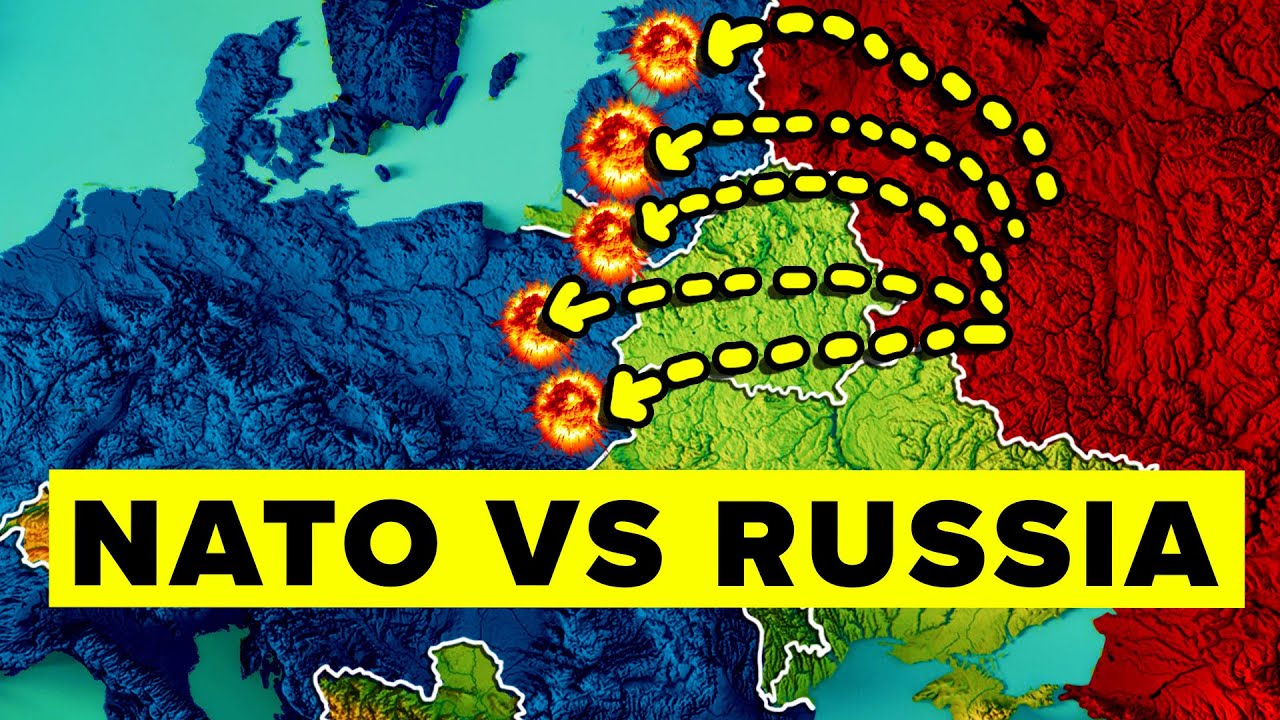
If NATO and RUSSIA Go To War, Who Loses (Hour by Hour)

A war between Russia and NATO might seem
impossible. After all, NATO currently consists of 32 member countries, including the United
States, Canada, the United Kingdom, and most of Europe. Collectively, NATO forces dwarf those
of Russia, both in terms of quantity and quality. So, how could a NATO/Russia war
possibly come to pass? Well, as uncomfortable as it might be to consider,
there are a few possibilities. For example, as very nearly came to pass in the 1980s, – what
if a NATO war game was misinterpreted by Russian intelligence as cover for an assault on the
motherland, leading to a pre-emptive strike? What if Russia decided to invade a smaller member state
on its border, pushing the red lines and seeing if NATO – most importantly, the US – responded?
The history between Russia and NATO has long been tense.
Despite a brief thaw after the collapse
of the Soviet Union and the end of the Cold War, these tensions are back at a deep freeze.
In fact, relations are arguably the worst they’ve been for half a century. Some
have said we’re in a New Cold War. Join us as we delve into this hypothetical matchup
and scenario, which aims to illustrate one key point: the US’s involvement and leadership are
critical. Without it, who knows what might happen? Hour 0
After years of planning, Putin’s generals give the go-ahead. They want a much further divide
between Russian borders and NATO countries. Their target? Lithuania and the Baltic States.
Taking Lithuania cuts Latvia and Estonia off from Europe, leaving them primed and
ready for a further Russian advance. It’s not just a territorial expanse, though.
The Russians feel utterly betrayed by NATO, and the US in particular. As the Soviet Union
collapsed, NATO officials had indicated – but not in any legally binding manner – that
NATO would avoid further eastward expansion, ensuring the new Russia didn’t feel vulnerable.
But it had reneged on that apparent promise, and Russia was – and still is – deeply angry.
Any potential trust was dead in the water as soon as any countries bordering Russia joined NATO,
leading to the inevitable re-escalation of tension and the potential for a new cold – or hot! – war.
The ongoing war in Ukraine hasn’t gone as planned. As of early-mid 2024, Russian armed forces have
taken a beating, with only around 1,750 tanks left in operational service – and that includes
a few antiques! It has around 1,200 bombers, fighters, and attack aircraft left.
But Russia must never be underestimated. Its infantry is even larger than in 2022, at the
start of the Ukraine War.
And despite significant equipment and vehicle losses, the production
chain is ramping up, and close relations with allies like China and Iran mean more and
more are piling into the inventory every day. After months of testing and probing,
including airspace and naval violations, as well as amassing troops on the border, Russia
has seen little military response from Lithuania’s NATO allies. Western leaders have verbally
condemned Russia’s thinly veiled threats.
Yet, nobody has sent missiles, ships, jets,
or reinforcements to their small ally. Ok. Hour 0 rolls around. Judgement time.
It’s the middle of the night. The few hundred tanks Russia has left, removed from the war in
Ukraine, are lined up on Lithuania’s border. They fire up their engines and, escorted by
100,000 troops, mostly newly conscripted, approach the crossings. Simultaneously, GPS and
radar jamming cripples Lithuanian navigation and communication systems, protecting the Russian
soldiers and armaments from most missiles. Russia launches a barrage of thousands of
sea- and air-launched missiles along with Iranian-built drones, first using its weaker,
cheaper, and more disposable subsonic models. Lithuania has very few air defence units, and NATO
hasn’t finished ratifying the deal that will see the country host its more advanced launchers.
The country’s aerial defences will be swiftly overwhelmed, at which point the supersonic
and hypersonic arsenal will come into play. Simultaneously, Russia launches its spare fourth-
and fifth-generation fighter jets, including older Sukhoi-27s and MiG-29s, as well as their newer
counterparts, the Su-30s, Su-35s, and a couple of brand new Su-57s.
The Lithuanian Air Force, the
LTAF, has no chance. No matter how excellent their training is, the numbers are overwhelming. Their
6 or so active aircraft are mostly helicopters and transport planes, no match for modern multipurpose
jets. Although the long-range radar stations in the east of the country see the Russians coming
a mile off, there’s nothing they can do. The jets are on top of them almost immediately, heading
straight for the LTAF air base in Šiauliai. Russia has two primary goals and
two secondary objectives.
First, it seeks to take Vilnius, the Lithuanian capital
near its border, before NATO can respond. Second, it will aim to seize land between Belarus
and Poland, slowing NATO land advances. Then, if it can conquer all three Baltic states without
triggering nuclear war, it will have significant access to the Baltic and a much greater barrier
between itself and NATO advances. And finally, even if it all comes to naught, Putin will
learn an awful lot about how NATO conducts war. Lithuania’s intelligence division, the VSD, has
expected this move for some time. After all, why else would an openly threatening country
line its troops up on the border? However, Lithuania’s pleas for assistance to NATO
allies have previously been swept under the rug.
Nobody else believed Russia would
start another war, especially considering its ongoing losses in Ukraine.
How wrong they were. Hour 1
The attack has been strategically timed. Almost all NATO leaders
around the world are asleep or preparing for bed. Only the American president and Canadian prime
minister are still awake, but they’re enjoying rare peaceful evenings with their families.
But intelligence operatives are wide awake. All around the world, NATO leaders are urgently
roused from their slumber and immediately summoned to high-security meetings. They’re informed of
Russia’s invasion. The British prime minister, French president, and German chancellor sleepily
try to grasp the severity of the situation. At the same time, their two North American
counterparts hold their heads in their hands: the world is on the brink of war, and Article 5
of the NATO Agreement forces their retaliation, along with 26 other countries
and, of course, Lithuania itself. But, legal obligations aside, is an aggressive
retaliation a plausible response? Will it save lives? Or, most crucially of all, will it
risk triggering an all-out nuclear war, mutually assured destruction of all major
powers, and millions of unnecessary casualties? The NATO Response Force, the NRF, and its 40,000
troops are primed and ready to respond.
They’ve been training for this and know that NATO can
quickly mobilise a further 300,000 soldiers, with millions more prepared to be called
up. But it needs the go-ahead. It can’t act without authorization from the top.
And the NATO leaders have a dilemma. NATO was implemented to deter Soviet expansion
and aggression, seeking to prevent conflict. Now that war has started anyway, they face an
unprecedented situation. How should they respond? Hour 2
NATO negotiators immediately try to open communication channels with the
Kremlin. They’re deeply concerned about the risk of worldwide nuclear war and outright destruction.
But nobody answers. And because nobody answers, NATO leaders are at a loss for what to do.
In fact, in Russia, Putin and his generals are purposefully ignoring the ringing red hotline,
waiting to see how the West will respond. What move will they make? Until such a time,
they’ll continue with the invasion as planned. Meanwhile, as dawn approaches, odd things start
happening in industries throughout Lithuania and its Baltic State neighbours, Estonia and
Latvia.
Breakers in power substations around the countries start mysteriously flipping off.
Bank networks go offline. Port gates stop working, and strange messages appear on the phones of
government officials and contractors. Before long, the vast majority of computers display
nothing more than a black screen and a ransom message demanding Bitcoin payment.
On the surface, it looks like an independent extortionist hacking group, but the strategic
timing leaves few in doubt. Russia’s elite hackers, such as the elusive GRU group known as
Sandworm, are almost certainly behind the carnage. As Lithuanians wake up in a war, they find
their heating and air conditioning systems offline. No matter; they’ve survived far more
than the relatively mild discomfort caused by a spring attack on infrastructure like this. But
they soon find it’s far more than their systems. Most of the power remains out, preventing
streetlights from working, electric cars from charging, and shops from opening.
Even more dangerously, software helping the armed forces direct their personnel and
organise strategic moves is utterly destroyed, along with all its backups.
Its
leaders and soldiers are resilient, though, and they turn to less conventional
methods to facilitate communication. These include WhatsApp communications through satellite
WiFi and even runners carrying notes to and fro. Hour 3
Lithuanian forces continue to engage the Russian onslaught, but there is very
little they can do without NATO support. Brave soldiers take out Russians at a ratio of more than
five to one. Still, the relentless wave of humans and machinery just keeps coming. Eventually, the
self-sacrificial defenders are forced to fall back or risk being overwhelmed and wiped out.
Where are its allies? Where is NATO? NATO is deliberating. European leaders
are, by now, wide awake and beginning to plan countermeasures. Despite the
encroaching night, President Biden and Prime Minister Trudeau in North America
down strong coffees and continue to work. Here’s the broader situation. Britain and France,
two of the strongest European powers, have nuclear weapons of their own. Other countries, including
Germany, Italy, and Belgium, have American nukes stationed within their borders. They’re all poised
and ready to fire them if necessary. But doing so would have catastrophic consequences.
Despite Russia’s significant losses of personnel and equipment in Ukraine and now
Lithuania, it still maintains the largest arsenal of nuclear weapons in the world,
with 5,580 warheads as of 2024.
Of these, 1,710 are deployed and ready to be launched on
a missile or loaded onto a bomber at a moment’s notice. The world’s other nuclear superpower, the
US, held 3,708 as of 2023, with 1,419 deployed. In contrast, the world’s other nuclear powers
hold relatively meagre numbers. Again, in 2023, China had 410, the UK had 225, France held
290, Pakistan had 170, India 164, Israel 90, and North Korea about 30. While these numbers may
pale in comparison, especially considering that most are likely not actively deployed, note that
modern nuclear weapons are often 50 to 100 times more powerful than those dropped on Japan at the
end of World War II. If just one hits its intended target, the damage would be unfathomable – too
great for the human brain to even comprehend. That’s why NATO is carefully considering its
next move.
Russia is unpredictable right now, testing the waters and seeing what it
can get away with. It’s looking for a fight – but it doesn’t have a death wish.
NATO leaders – and most importantly, the US – must choose their play carefully. The
discussions are tense and drag on. All the while, Lithuanian soldiers are being pushed
further and further back, with ground forces entering the outskirts of Vilnius.
The tragic deaths are mounting. Hour 4 NATO boffins have been working away at the Russian
cyberattack, isolating and reverse engineering the malware. Whoever is behind it is a genius.

The
destructive code has been a ticking time bomb, isolating unknown weaknesses in Windows operating
systems and using these to spread through local networks. At the invasion’s preset date –
which must have been in the minds of Russian military planners for months – the malware
code ran, wiping all the data in its path. While the Baltic States aren’t the only
ones affected, the bulk of the operational damage is concentrated in these areas.
With NATO’s help, the Lithuanians bring some power systems back online. It was a temporary
handicap, but one which was extremely costly. As Lithuanian forces fall back, their
communication systems come back online. This, combined with the never-say-die attitude of its
armed forces, turns the battle towards guerrilla tactics. This begins to have a devastating morale
impact on the Russian troops, who are seeing their comrades killed in huge numbers all around them.
Like the Ukrainians, the Lithuanians use their knowledge of the terrain and their force of mind
to slow the Russian advance, proving particularly effective against the old and cumbersome tanks.
Meanwhile, relatively safe in their comfortable meeting places throughout Europe and North
America, the US finally decides what to do. Its fellow member states agree and turn to
the job at hand with grim determination. NATO will reinforce Lithuania, Estonia, and
Latvia with troops, tanks, aircraft, ships, submarines, missiles, and missile defence systems.
The overwhelming numbers and the quality of the individual units and troops should prove more than
a match for Russia.
However, NATO allocates the US to contact the Russians, explaining in clear
terms that nuclear weapons are not on the table. Not yet, anyway.
With their forces already gathered and ready, NATO sends supplies,
armaments, and Response Force troops to the Baltic States. Countries begin mobilising their
standing armies and calling volunteers to enlist. The European navies, notably Britain and France,
aren’t what they once were. They must wait for reinforcements from the Italians while the far
more extensive American fleet begins the journey to join them.
In the meantime, the USS Ronald
Reagan aircraft carrier, the final iteration of the nuclear-powered Nimitz-class vessels, with its
F/A-18 Super Hornets and E-2 Hawkeyes, is already in the area, despite usually being part of Carrier
Strike Group 5 operating in the Indo-Pacific. NATO can respond quickly. However, one question
remains: Will they reach the Lithuanians in time? Day 2
The fighting rages on all day before nighttime brings a brief reprieve for most.
Special Forces operations from Lithuania, NATO, and Russia continue to penetrate across the lines
in both directions, springing devastating surprise attacks and assassinations, but the battle lines,
just outside Vilnius hold relatively steady. It isn’t looking good for Lithuania.
Despite fierce resistance, the Russian forces simply keep on coming. Although
the NATO alliance is on the way, there’s little it can do to keep the onslaught at bay.
Its leaders consult what to do. They know that every second the fighting continues, more men
and women die. But, with ships, aircraft, and vehicles steamrolling in to reinforce them, they
just need to hold out a bit longer.
The decision is made that the sacrifice of the country’s brave
soldiers is worth it. If Russia takes the capital, they might never see independence again.
By the second day, most power companies are back online, their systems restored from obscure
backups. There are still a few glitches and areas where administrators struggle to bring industries
back from cyber destruction. Still, things look far more positive than the previous day.
Buildings in Vilnius are being flattened, with civilian deaths mounting. Artillery and missile
fire takes down critical infrastructure, including power stations, transformers, and even hospitals.
The situation is dire. There’s no support from the ground or the air – the tiny LTAF has been
destroyed before it even left the asphalt. Meanwhile, NATO introduces even more official
sanctions on Russia, hitting its economy hard. Without the vital trade, Russia notices the first
signs of struggles. However, plenty more countries outside of NATO rely on Russian imports and
exports, notably China, Iran, Belarus, and North Korea.
Although their trade is significantly
reduced and the stock markets take a hammering, Russian forces show no signs of slowing down.
The Lithuanian armed forces are growing tired as the day draws to a close. Russian armaments
continue to pour over the border in droves; missiles rain down, with the local missile
defence systems completely overwhelmed; civilian deaths and infrastructure
damage are rising exponentially. But as evening comes, the first signs of
hope arrive. Fifth-generation jets land in neighbouring Poland, ready to launch devastating
counterattacks. Vehicle-borne missile launchers, used for attack and defence, arrive in
neighbouring countries and Lithuania. These immediately kick into action,
significantly reducing the damage from the air and providing Russian jets and bombers
with a substantially more complex adversary.
Day 3
Throughout all this time, Russia has had a gaping hole. The Baltic Sea. With
all of Scandinavia now in NATO, there are plenty of places from which Lithuania can be reinforced,
and sea access to the country can be maintained. Russia’s Baltic Sea Fleet consists of only one
traditional old Soviet submarine, Dmitrov. In fact, it’s one of the oldest submarines in the
entire Russian navy. Despite about two frigates, 27 corvettes, and a few landing craft, the Baltic
Sea fleet is hopelessly outdated and focused more on intelligence and troop movement
than military might. Its one destroyer, the Sovremenny-class Nastoychivyy, has been in
repair since 2019. The Baltic Fleet simply hasn’t been the priority next to, for example, the Black
Sea Fleet or the Northern Fleet in the Arctic. At the start of the third day of the war,
Russia contacts NATO. The combined fleets have reached distances at which they can engage.
Heavy artillery begins raining down on Russian positions, and Russian naval bases in Kaliningrad
are immediately overwhelmed. NATO naval forces are simply far greater in numbers and firepower.
And it isn’t just at sea that NATO begins to take the advantage, supporting its small
member state.
Missile launchers line up, keeping a significant distance from each other to
ensure safety in isolation. Russian jets now have a considerable problem avoiding missiles from the
advanced Patriot missile defence systems. Almost all Russian missiles are now being intercepted,
and Lithuania and NATO begin counterstrikes on Russian-held positions and reinforcement points.
NATO jets join in, pounding targets relentlessly. Russia’s air defence systems are put to work, but
as time passes, NATO missiles are being constantly resupplied, and fifth-generation fighters,
with enhanced missile evasion capabilities, keep coming.
Russia, on the other hand, has a
limited supply of both missiles and jets. And it can’t afford to significantly reduce its
significant stock or needlessly expend its hypersonic missiles or fifth-generation fighters
in case of a more impactful future conflict. It’s time to talk.
Negotiations begin. But in the meantime, the fighting continues.
Putin is determined to learn as much about his enemy as he can. Likewise, NATO troops fight
with renewed resolve for a free Lithuania. Although most NATO leaders are now confident
in victory, they aren’t yet sure when that will come around, nor the total cost
of the war once arms are laid down. Week 2
As the war drags into its second week, the tide decisively turns
in NATO’s favour. Superior numbers and superior quality in those numbers mean the NATO armies have
a massive advantage.
F-35C aircraft from aircraft carriers dominate Russian-held positions, backed
up by Europe’s favoured Eurofighter Typhoons. With footholds and FOBs established throughout Poland,
Estonia, and Latvia, they pound Russian forces from the north and south, reinforcing in swarms.
Naval bases in Sweden, Norway, Finland, and Denmark allow Allied ships to repeatedly
dock, resupply, and come back at the trapped Russian forces, decimating their Baltic Sea
fleet and honing in on Kaliningrad, Russia’s main seaport. With the Danes controlling access
to the Baltic from the North Sea, Russia has virtually no chance of breaking out. Their
only hope is to surrender or fight alongside attacks on harbours or logistics chains.
Fortunately for Russia, cyberattacks are its specialty. Government hackers launch a barrage
of Distributed Denial of Service and malware probes toward the Scandinavian-owned NATO ports.
They have some initial success, with dock workers and sailors becoming confused and losing access
to schedules and cargo information.
This leads to long lines of ships stretching out into the
sea – and these NATO vessels are vulnerable to attack. Russian missiles, jets, and their
naval fleet turn to attack the ships and succeed in doing critical damage to a couple.
But they’re overwhelmed and forced to retreat by the hastily assembled escort warships.
Cyberattacks can bring an immense temporary advantage. However, cybersecurity experts
usually find a way to restore backed-up data or work around the malware within a few
days – sometimes a few hours. In this case, NATO cybersecurity experts have the port
systems back online and up to date in a few hours.
It takes only a couple of days for the dock
workers, working overtime, to get back on track. As Russia is pushed further and further
back, things appear increasingly gloomy. Month 2
Russia begins to consolidate its forces. Putin knows he’s not going to make
any further progress against NATO and rallies all his troops back across the Russian border.
But there’s one last move in the book and one that shakes Biden, Sunak, Scholz, Macron, Trudeau,
and the rest of the NATO leaders to their core: intelligence suggests that nuclear weapons
are being prepped for launch in Kaliningrad and South Belarus.
With no other option, NATO quickly decides it must act, preparing
nuclear warhead-tipped Tomahawk missiles. Although Russia still has plenty of missiles,
the invasion of Lithuania was never intended as a territorial expansion or a declaration of war
on the rest of NATO. Russian leaders would never take such outrageous action. Not without good
reason to believe in their success, at least. No. Instead, the Lithuanian invasion was always
very likely to fail. It was always going to end up as a test, a sort of tragic live-fire
exercise. A test of Russia’s capabilities. An examination of how NATO would respond.
Would
nuclear weapons be on the table? Would the States get involved? Or would it refuse
to risk escalating the conflict further? Russia hasn’t gained any military ground
or established any footholds. It will soon inevitably be forced to retreat. And yet, that’s
what Putin and his leaders always suspected would happen. In fact, they’re fascinated by how
the events have played out. NATO countries were far more willing to reinforce Lithuania than
many in the war cabinet had imagined. Equally, the initial response from NATO was fraught with
confusion, hesitation, and a hint of panic. Even as NATO missiles pound down, decimating their
forces, Russia feels a gleam of satisfaction – it has learned a lot. It doesn’t take long for the
surrender and peace agreement to be reached, in which Russia promises never to invade
again and to pay for the damages sustained to Lithuania and the NATO forces.
Putin and his government smile. They lost the battle – decidedly. But
next time, things might be different. What do you think a war between
NATO and Russia would look like? Who would com eout on top and
why? Let us know in the comments! Now go check out If US and China Go To War, Who Loses (Hour by Hour) or
click this other video instead!